

Assessment centers are invaluable tools in the recruiter’s arsenal, perfect for evaluating key skills required for leadership roles such as decision-making, collaboration, and strategic thinking. They are also highly effective in large-scale hiring campaigns, like graduate programs or entry-level positions, where they streamline the process of assessing multiple candidates. Furthermore, for roles that demand specific abilities like teamwork, negotiation, or problem-solving, assessment centers provide recruiters with a hands-on way to observe these competencies in action through practical simulations and group exercises.
However, assessment centres can be challenging for candidates. Unlike traditional interviews, you can’t simply bluff your way through an assessment centre. Well, not that simply. Preparing can also be more complicated, especially if you are not sure what types of exercises to expect. A lack of experience or misunderstanding the instructions can lead to responses that miss the mark—mistakenly suggesting you lack the necessary skills. So, what can you do to succeed? Check out my guide:
What Is an Assessment Centre?
An assessment centre (AC) is a selection procedure that consists of several individual and group assignments which may also include personality, cognitive and technical skills tests. Your performance will usually be judged by a panel of three or more observers. Depending on the role, there may be up to 15 candidates in a group. The whole procedure typically takes from half a day up to two days.
Typical AC Activities
Group Interview
You may be subject to an individual interview as a part of AC as well. However, if there are more than three candidates, more likely there will be a group interview. The questions are usually (almost) the same as in an individual interview—so you can conveniently prepare based on my earlier article here: Mastering Job Interview Questions (Plus a Free Cheat Sheet). The flow will be very different though: candidates in the group are usually asked to answer the same question one by one whilst the time will be strictly limited so you should do your best to deliver a crisp and short answer to the point.
Debate
You can be given a certain topic related to the industry or even a specific job-related task and asked to start a discussion in a group. For example: “Discuss the impact of X technology implementation on the Y industry.”
Simulated Tasks
One of the most typical simulated tasks is to design a project plan and present it to the observers. The topic can be related to the job, or it can be something from ordinary life, or even something seemingly completely irrelevant. For example, preparation for a birthday party, building a bridge, or implementing a new production line in a factory. This can be administered both in a group or as an individual task.
When given a simulated task, think quickly first about what you are going to deliver and how you are going to deliver it, and then work out the details. Make use of all the presentation tools available—projector, flipchart, board, markers, pins, stickers, etc.
Personality Assessment
Personality tests typically consist of a set of statements with which you are asked to express your level of agreement or disagreement on a scale The scale may be numbered and/or the points may be labelled (“totally disagree”, “somewhat agree”…). Sometimes the scale will not have a midpoint (there will be an even number of points to choose from) in order to force you to take one or the other side. You may be also asked to choose between two options, both being generally favourable or unfavourable—for example, they let you choose between “I am rather lazy” vs “I am rather forgetful”.
It is difficult to prepare for a psychometric assessment because of several reasons:
- There are rather many and you can’t learn all of them.
- They usually have a “lie scale” built in—a set of items and other control mechanisms that can indicate whether a respondent has been truthful in answering or not.
- You cannot assess which answers are “good” and which are “bad” as such. The result will come out as some sort of a personality profile which the recruiter will then compare with the desired profile for the role. Unfortunately, you will neither know how to answer the questions to generate a certain type of profile, nor what exactly their desired profile looks like.
The only way you can prepare is to get in the right mindset beforehand (see my other article, The Perfect Preparation: How to Ace Your Job Interview). Then, go through the test rather quickly—the first answer that comes to your mind is usually the best.
Cognitive Assessment
Cognitive tests measure your reasoning, perception, memory, verbal, mathematical and problem-solving abilities. They usually contain a series of multiple-choice questions and are limited in time. There is usually only one correct answer to each question. Some online tools like HireVue use game-based cognitive assessment. Each game measures a different aspect of cognitive ability or job-related competency. Some games are reminiscent of puzzle games you might find on a smartphone; others are more utilitarian and reminiscent of traditional cognitive tests.
You can prepare and improve your score in cognitive tests by practising mock tests. In fact, I recommend you practise cognitive tests regularly since it will not only help you pass this part in the AC but also keep your mind fresh and sharp whilst looking for a job.
Case Studies
Case studies are exercises where you face a challenge to read and interpret various business data. The data can be a mixture of qualitative and quantitative and usually simulates real-life scenarios typical for the job. Case study topics can vary, for example deciding on a project to invest money in, considering an organisational change, a company merger, entering new markets or designing a marketing campaign for a new product. Analysing the job description and diligent research into the company will help you understand what types of situations may occur in the role and prepare accordingly. I also recommend practising business case studies in general in order to sharpen your business acumen.
Role Play
In a role-play exercise you will be provided with a particular role, background information on the situation, and the desired outcome. An example of a group role-play exercise is a mock project meeting, in which each candidate assumes a specific role in the project, and must fulfil their respective objectives (which are usually contradictory), as well as the group objective. Another typical example would be a mock meeting with a subordinate who is not performing according to expectations (in which case you would play the role of the supervisor and the subordinate would be typically played by one of the observers).
You can prepare for a role-play exercise by rehearsing some of the commonly used scenarios with someone who has been trained and has experience as an AC observer, or with your career coach. I don’t recommend practising with just a friend as you may not get accurate feedback from them.
Technical Tasks
If the job requires specific technical knowledge, you may be asked to complete a technical test or demonstrate your skills in practice. For example, if you want to be hired as an excavator operator, you can be sure that they put you into an excavator and ask you to dig a groove for a wall footing or something similar. There is no better way to prepare than to make sure you simply know your stuff well.
What Are Employers Actually Looking for in an AC?
In every group exercise, you will not be judged just based on the outcome of each activity, but also (and maybe even more importantly) based on your approach, behaviour, and interaction with other candidates in the group and with the observers. The observers will typically rate each participant based on a set of criteria the company believes are the most important for the job.
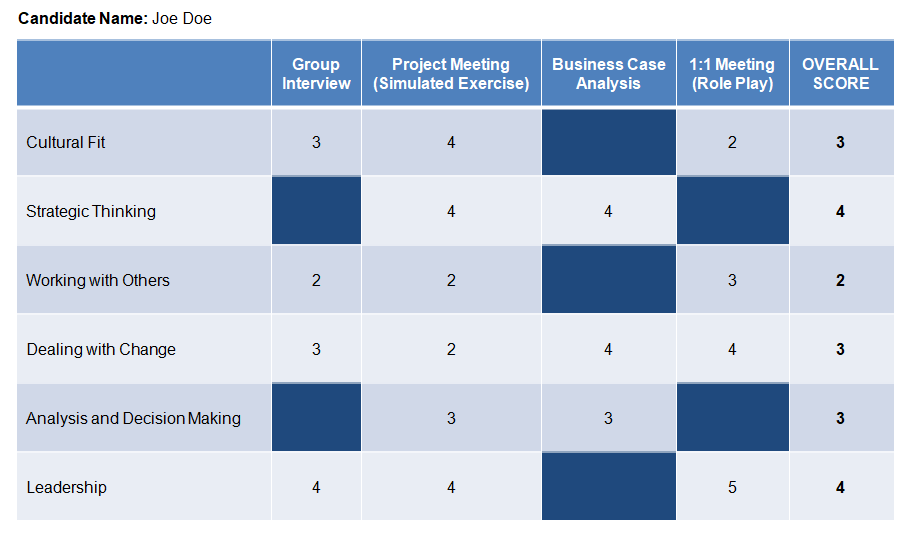
Assessment Centre Scoring Sheet Example
Keep in mind that you will be observed throughout the whole time. And I mean whole— you will be observed during breaks, lunch, even if you pop out for a pee. Therefore it is crucial for your success to always stay in your role until the AC is over and you leave the premises. You may bump into one of the observers in the bathroom or car park afterwards and just one inappropriate remark may be enough to get you eliminated.
Building Rapport
It is very important to introduce yourself to the rest of the team at the beginning. This will help break the ice between you and show observers you are taking steps to build rapport with the team. Also, you can get the team to introduce themselves. It is another important step in ensuring that everyone feels comfortable around each other, and this will show observers that you are taking the initiative and organising the group. However, if someone else does that before you, don’t worry. Once you know your fellow candidates’ names, use them in conversation with and about them; avoid using pronouns. This will help put everyone at ease, and show observers that you can build rapport, treat everyone as individuals and can make strong first impressions.
Giving Feedback
Giving constructive feedback to your peer participants is essential to get the most out of every exercise. Acknowledge valuable participation from other candidates and give praise when possible. Even if they come up with utter nonsense, acknowledge their contribution and formulate your feedback as advice or suggestions on how to make it better.
Never give negative feedback to other candidates. If a candidate generates an idea or does something which you do not agree with, do not criticise them, not even after the exercise has finished. Not only would negative criticism put the rest of the team on edge and make them feel less comfortable around you (which would limit your ability to interact with them throughout the rest of the AC), but you would also seem less diplomatic and less patient, which usually puts off the observers. Never comment or correct others’ inappropriate behaviour—leave it to the observers to evaluate (unless correcting them is explicitly required as a part of the role you were assigned in an exercise or the situation escalates beyond tolerable level).
Collaboration
Collaborative behaviour is a quality sought after by most employers. Do not think of your peer candidates as your competitors for the position you want. Similarly, do not try and show off or out-compete your peers. In any group exercise, facilitating teamwork will impress observers. Aggressive individualism, excessive competitiveness or even fighting or letting your peers down will be a serious put-off for observers and will be noted as poor performance.
On the other hand, if you are criticised or attacked by another participant, do not fight back and accept it with grace. In the end, their improper behaviour will increase your chances.
Active Participation
It is essential for you to be seen as an active participant. Never miss an opportunity to contribute your ideas and views while actively listening to other candidates. Since they are also trying to participate, someone may make your point first. In such a case, think of a statement that complements their point or even integrates views from other participants. This will demonstrate that you are an active listener as well as a quick thinker.
How to Prepare for an Assessment Centre
Besides the standard preparation like for a normal interview, you should learn how to behave and perform the AC tasks. All activities will be strictly limited in time—to ensure fairness towards all candidates and also to see how you can perform under pressure. Hence, you have to work really fast and allocate your time wisely.
Typically, you will receive the task together with some input information, get some time to process it and then have to perform or present the solution or result. I recommend sorting out all the input information quickly first, separating important from unimportant and structuring it into logical clusters before you start working on the solution. That will help you familiarise yourself with the task and recognize where the main issues are. You may consider using a common business framework like a SWOT or PESTLE analysis, People-Process-Technology (PPT) etc. to analyse the task. These can also be used in certain tasks to formulate your responses, especially in a case study exercise. By doing so, you will also demonstrate your command of the framework.
Sometimes the task will require you to use your own knowledge and understanding. In other cases, you may need to undertake the task purely on the information that was provided to you. You can be even intentionally provided with incomplete information and it will be tacitly expected that you come up with alternate solutions considering different variables in order to see how you can cope with ill-defined problems.
As a general preparation, you should develop a deep understanding of the industry sector the company operates in by following relevant news stories, and online discussion fora and keeping abreast of the most recent developments. I would also encourage you to practise some of the types of tasks typically used in an AC if you want to get ahead of your competition.
Conclusion
Assessment centres are complex but valuable recruitment selection methods. They may seem challenging for a candidate at first, but with careful preparation and awareness of common pitfalls, you can turn these exercises into opportunities to shine. Remember that each group exercise, simulation, or discussion is a chance to demonstrate your skills and showcase your problem-solving and interpersonal abilities. Embrace the process with confidence and flexibility, and let your true strengths guide you toward success in your job search.
Good luck!
You May Also Like:
- Navigate Your Job Hunt with Confidence to Attract the Best Opportunities (Plus a Free Resilience Worksheet)
- Feeling Nervous at a Job Interview? Here’s What to Do (Plus a Free Autogenic Training Aid)
- How to Answer Behavioral Job Interview Questions
Do you want to get new posts directly to your mailbox? Subscribe here.
Do you need my personal assistance? Simply send me your resume and a link to your LinkedIn profile at vaclav@getyourdreamjob.co and I will come back to you!
 Get Your Dream Job