
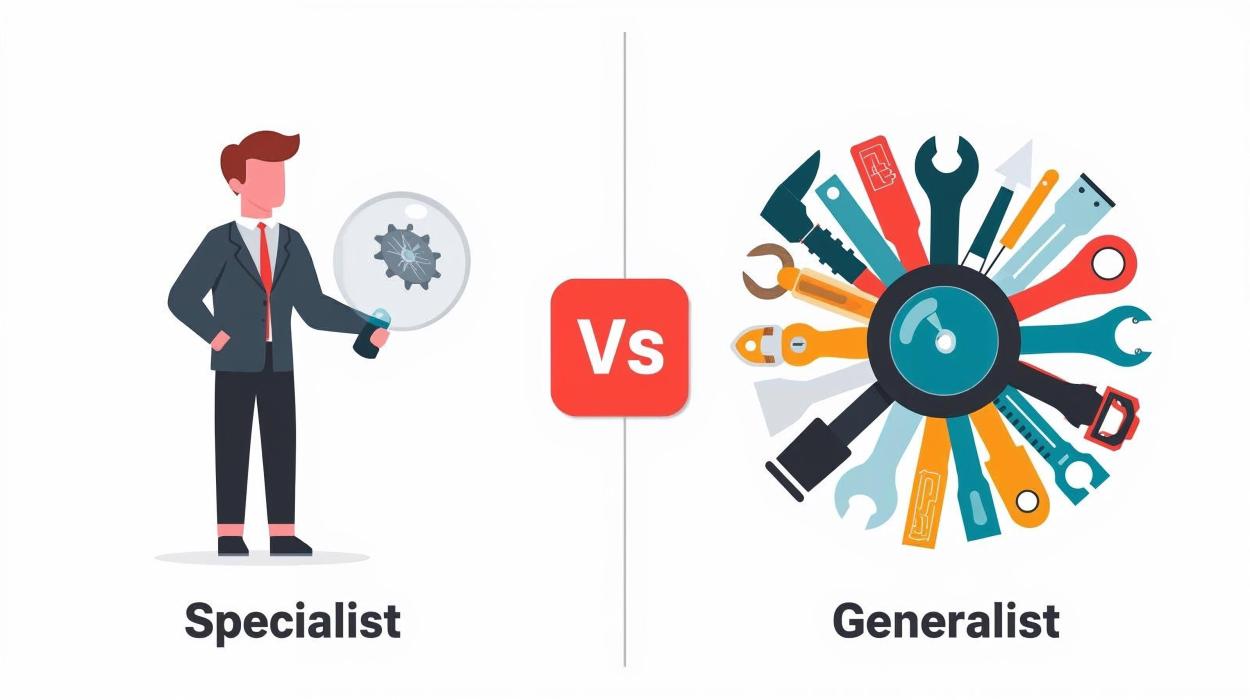
When you start shaping your career path, you will soon face two distinct options: becoming a generalist, with a broad set of skills across multiple areas, or a specialist, focused on deep expertise in a single domain. Both paths can lead to rewarding opportunities, but they tend to thrive in different types of organizations.
Smaller companies typically favor generalists, as their diverse skill sets and adaptability allow them to contribute across various functions. These businesses often lack the resources to fully utilize narrowly focused specialists. In contrast, larger companies often seek specialists—especially for complex projects or advanced technologies—where deep knowledge and expertise are essential.
Do You Want to Be a Specialist?
Who Is a Specialist?
Specialists are professionals who pursue deep expertise in a specific field—such as data analytics, commercial law, or petroleum engineering. They’re driven by a desire to master the details and complexities of one domain, often becoming the go-to experts in their area.
Employers frequently seek specialists for roles that involve complex challenges or require advanced knowledge of a particular subject or industry. For example, a drilling engineer might begin with a degree in petroleum engineering, then choose to focus specifically on the design, operation, and maintenance of oil drilling equipment. Over time, they may further specialize in niche techniques like horizontal drilling, making their expertise even more valuable.
Advantages of Being a Specialist
Specialists are often highly valued by employers for their deep expertise and ability to tackle complex challenges within a specific domain. Their specialized knowledge can command higher salaries—particularly in the early stages of their careers—and they typically face less competition in the job market, especially when their skills are rare or in high demand.
Beyond traditional employment, specialists can leverage their expertise to build a strong personal brand and generate additional income. Opportunities such as part-time lecturing, consulting, or speaking engagements allow them to share their knowledge while expanding their professional influence and network.
Challenges of Being a Specialist
While specialization offers many advantages, it also comes with risks—especially in a fast-changing world shaped by technology, artificial intelligence, and automation. A specialist’s deep knowledge in one area may become outdated or less relevant rather quickly. Because their skills are highly specific, transitioning to a new field or reskilling can be more difficult.
To stay adaptable, specialists should actively develop transferable skills—such as communication, problem-solving, or project management—that can be applied across industries and roles. This helps safeguard their career against shifts in demand and opens up broader opportunities.
Considering a Path as a Generalist
A generalist is someone with broad knowledge across multiple domains. These individuals often possess a wide range of passions, skills, and interests, making them naturally inclined toward variety and versatility. Repetitive tasks and long-term routines may feel stifling to them; instead, they thrive when managing diverse responsibilities across different departments or functions.
With time and experience, generalists can evolve into strong leaders. Their holistic understanding of various aspects of a business, organization, or industry enables them to connect the dots, make informed decisions, and lead with agility.
Advantages of Being a Generalist
Pursuing a generalist path can be highly rewarding, especially when navigating major career transitions, such as shifting to a different industry or embarking on an entirely new profession. Generalists often cultivate a broad set of transferable skills, making it easier for them to shift between roles or industries. Even with a technical background, they are frequently considered for dynamic positions in areas like human resources, communications, or marketing.
Their adaptability allows them to thrive in new environments and take on diverse challenges with confidence. While it may take longer for generalists to reach peak earning potential, they typically catch up over time. Many eventually pursue more ambitious roles, often rising into management or leadership positions where their wide-ranging experience becomes a strategic asset.
Challenges of Being a Generalist
Despite their versatility, generalists may face certain drawbacks. Their broad skill set can sometimes be perceived as less distinctive, making them more vulnerable to redundancy or replacement. Without deep expertise in a specific field, they may find it harder to stand out during recruitment processes or secure roles in highly specialized industries such as technology or medicine.
To mitigate these challenges, generalists can focus on opportunities within smaller organizations that value adaptability, cross-functional capabilities, and a wide-ranging skill set. These environments often reward flexibility and offer room for growth across diverse roles.
What Are T-Shaped People?
So-called “T-shaped people” combine deep expertise in a single domain (the vertical stroke of the “T”) with a broad set of complementary skills and knowledge across multiple areas (the horizontal stroke). This blend enables them to contribute as subject-matter experts while collaborating effectively with professionals from other disciplines.
In today’s rapidly changing workplace, T-shaped individuals strike a balance between specialist depth and generalist versatility. They can dive deep into complex problems within their field and pivot to support cross-functional projects, making them especially valuable for teams that need both focused insight and adaptive collaboration.
Conclusion
In the ever-evolving landscape of work, the choice between becoming a specialist or a generalist is less about right or wrong and more about aligning with one’s strengths, values, and long-term goals. Specialists offer depth and precision, thriving in roles that demand expertise, while generalists bring breadth and adaptability, excelling in dynamic environments that value versatility. Each path carries its own set of challenges—from obsolescence to lack of distinctiveness—but both can lead to fulfilling careers when approached strategically. Ultimately, success lies in knowing how to leverage your unique profile, continuously learning, and positioning yourself where your skills make the greatest impact.
Good luck!
You May Also Like:
- Navigating Career Change: How to Make the Switch (and Earn More Money)
- Skills You Need to Learn to Earn High Income and Achieve Great Career Success
- How to Choose Between Jobs: A Practical Calculator
Do you want to get new posts directly to your mailbox? Subscribe here.
Do you need my personal assistance? Simply send me your resume and a link to your LinkedIn profile at vaclav@getyourdreamjob.co and I will come back to you!
 Get Your Dream Job