
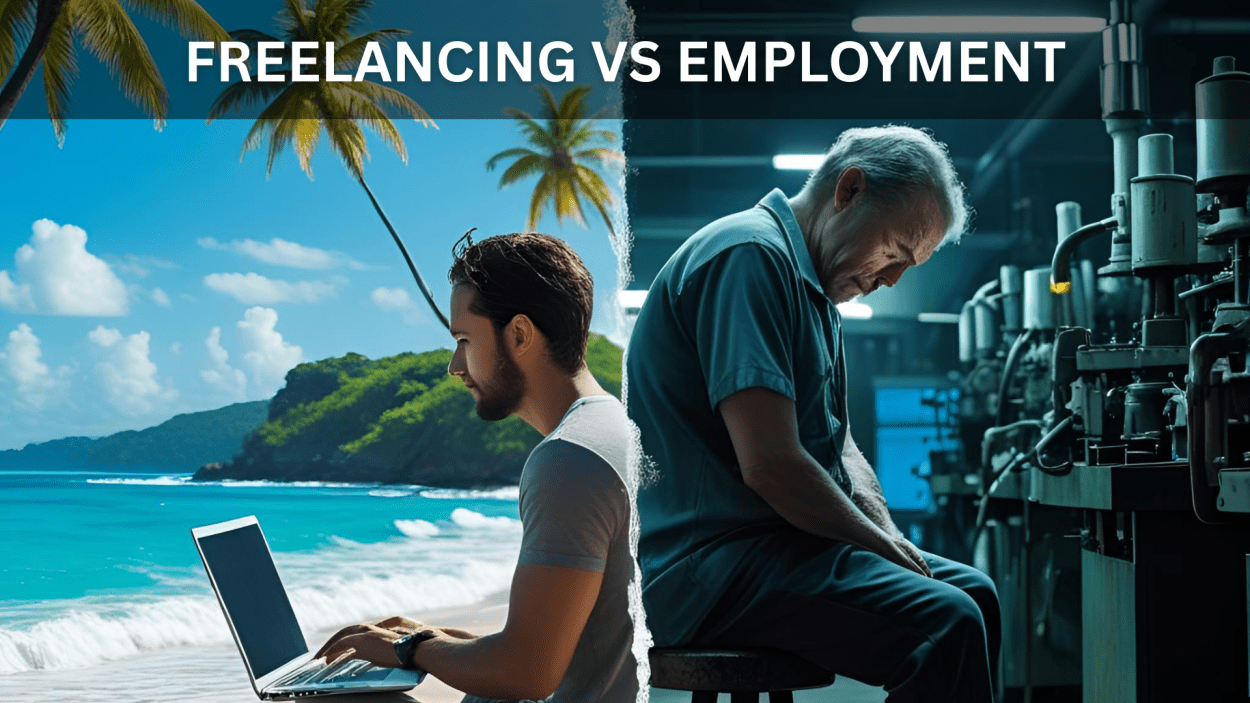
Today’s professional world offers a variety of career paths. One key decision is choosing between the stability of a regular job and the flexibility of freelancing. Freelancing can also be an appealing option if you’re struggling to find employment or build experience. In certain industries and for specific skill sets, freelancing isn’t just common—it’s become the predominant mode of employment.
In this article, I explore both paths, examining their unique features, key benefits, and also some of the challenges they present.
Freelancing
Freelancers are self-employed professionals who work independently, offering their services to various clients on a contract basis. Essentially, they act as their own business owners—taking care of everything from marketing and client relationships to handling taxes. Being your own boss also means investing in the tools and equipment you need to do your work.
The Freedom
One of the main perks of freelancing is the freedom it offers. Whilst freelancers still have to accommodate the wishes of their customers, ultimately they are the ones who decide when, where, and how they work—or whether they would rather decline the job. Thanks to modern digital technology, most freelance work can be done remotely or through a hybrid approach, giving freelancers the flexibility to travel and work from nearly anywhere.
Money, Money, Money
Freelancers have the ability to negotiate their project rates directly with clients, and by strategically managing multiple clients or projects simultaneously, they can potentially earn more than their counterparts in traditional salaried positions. Beyond direct compensation, freelancers can also benefit from significant tax deductions. Business-related expenses, such as home office costs, equipment, and travel expenses, can often be deducted from their taxable income, potentially leading to savings compared to traditional employees. Freelancers who work remotely might consider relocating to a country with a lower cost of living while serving clients in high-cost countries. This strategy allows them to offer rates that still yield a healthy income, yet remain significantly lower than the personnel costs a client would incur by hiring a regular employee, making them highly competitive.
On the other hand, freelancers are usually hired on a short- to mid-term basis and paid according to the work they deliver—sometimes only after completing a task or project. When the work is done, they must find new clients, pitch their services, and pursue additional sources of income. This means that workload—and, consequently, revenue—can fluctuate significantly between projects, requiring prudent cash flow management. They also have to manage their own benefits, such as healthcare and retirement planning, which often necessitates applying advanced long-term financial strategies.
The One Man Show
Choosing freelancing also means stepping into the role of a business owner. It’s not just about your technical expertise; you also need skills in marketing, financial management, legal basics, and client relations. The administrative work, which can feel overwhelming at times, is a natural part of managing every aspect of your business—something that would usually be handled by different departments in a traditional company. Therefore, robust financial planning and a solid understanding of business laws and regulations are essential to safeguard your future.
Employment
Traditional employment means working for one employer under a formal contract to fill a specific role within the company. Employment contracts spell out the terms and processes, roles and responsibilities in the organization are clearly laid out, and decision-making typically flows from top management down. Employees are generally assigned tasks by their supervisors without much room for negotiation.
Ball and Chain
Most often, a regular employment involves a full-time commitment with set working hours—such as the notorious 9-to-5 workday, Monday through Friday. In most countries, full-time work typically requires a minimum of 40 hours per week. If you need time off to attend to personal matters or travel, you will be limited by your annual leave entitlement; otherwise, you may have to apply for unpaid or replacement leave—all subject to your manager’s approval, of course. This can become particularly challenging when you need to care for school children or other family members who require your care, or when you have other personal commitments.
Moreover, most traditional jobs take place in an office setting where you are expected to arrive at a set time and location every day, which means a daily commute, resulting in lost time spent in traffic, and incurs additional costs.
Read also: How to Get a Remote Job, Abroad or at Home
Steady and Regular
You’ll typically receive payment as a steady regular hourly wage or a monthly (or weekly, in some countries) salary, with a possibility of overtime pay and various other allowances added on top (depending on local laws, your contract, and company policy). One of the major perks is that your employer often provides a range of benefits: healthcare, retirement savings plans, and paid time off. Plus, things like income tax, social security, and medicare (or its equivalent in your country) are neatly deducted from your paycheck. Companies (especially large) often invest in your career growth, offering training, and opportunities to take on new challenges, such as overseas assignments etc. On the other hand, your financial advancement will be limited to the yearly increment (if the company does one or it is mandated by the law or labour union in your country) or you have to earn a promotion, providing there is an opportunity (which in smaller companies may not be as easy).
Read also:
- How to Earn More: Strategies for Increasing Your Salary
- Build a Strong Working Relationship With your Boss to Propel your Salary and Career
- How to Leverage Resignation to Gain Salary Increase
Seeming Stability
Employment often seems like a safe bet—you expect to work at a company until you decide to leave or until your role comes to a natural end, like when you retire. But the reality is sometimes harsher. You might end up losing your job faster than you expect. Maybe you’ll miss a couple of deadlines, or your boss will accidentally learn what you really think of him, or even worse—the company might decide to replace you with AI overnight. And sure, you might get a severance package or some other kind of safety net, but finding a new job before your money runs out can be challenging, especially when the economy is tough.
Read more:
- Layoff Survival Guide: Hope for the Best, Prepare for the Worst
- AI and the Future of Work: How to Stay Relevant in an Automated World
- How to Avoid Getting Fired
So Which One Is Better?
Let’s take a look at the key parameters of both freelancing and regular employment in a clear table:
| Category | Freelancer | Traditional Employee |
| Employment Status | Self-employed entrepreneur, can have many customers | Works for single employer under employment contract |
| Control & Autonomy | High control over how, when, where work is done | Employer controls terms, conditions, processes, and task assignments |
| Compensation Structure | Project-based charging, or retainer fee; fluctuating income | Regular salary; steady, predictable income with possibility for overtime |
| Benefits | Self-funded | Employer-provided |
| Tax Responsibility | Pay income tax once a year (usually lower than combined employer/ employee portions); no withholding | Employer withholds income tax, deducts social security, health insurance, and other statutory deductions |
| Work Environment | Flexible; the freelancer decides | Usually office-based/fixed location; employer sets environment |
| Job Security | Contract-to-contract; potential for gaps | Long-term or permanent contract |
| Responsibility | Full business responsibility (marketing, invoicing, client relations) | Specific job responsibilities; reports to manager; tools/training provided |
| Career Development | Self-directed growth, upskilling, agency building | Structured progression, promotions, in-house training |
| Tools & Expenses | Buy own tools/equipment; pay business/travel expenses | Employer furnishes tools/equipment; pays/reimburses expenses |
| Legal Protections | Contractual liability; relationship subject to commercial law | Stronger employment law protections; e.g. protection against sudden termination |
When it comes to choosing between freelancing and traditional employment, it’s really a trade-off between enjoying the freedom and flexibility of freelancing and benefiting from the stability, perks, and clear growth paths of a regular job.
Freelancing lets you be your own boss—giving you the chance to manage your schedule, work from anywhere, and build a diverse skill set. However, it also means you have to handle all the ups and downs of running your own business, from unpredictable income to managing benefits and navigating a sometimes bumpy financial road.
On the other hand, traditional employment gives you a steady paycheck, robust benefits like healthcare and retirement plans, and clear career progression. But it might also mean a more rigid schedule, slower income growth, and dealing with organization-specific processes and bureaucracy.
The Bridge
But freelancing isn’t just an alternative to traditional employment—it can also serve as a crucial bridge between two permanent jobs. When you’re transitioning from one role to another or finding yourself between full-time opportunities, engaging in freelance work allows you to maintain a steady income, continually update your skills, and expand your professional network without the long-term commitments of a conventional job. This flexibility not only provides financial stability during uncertain periods but also enriches your resume with diverse experiences, making you a more attractive candidate when you eventually return to traditional employment. Embracing freelance gigs during a career transition can be a smart strategy for keeping both your career momentum and professional confidence intact.
Read also: Explaining a Gap in Your Resume: 3 Easy Strategies That Always Work
Conclusion
Ultimately, the best choice depends on your personal circumstances—your financial priorities, your comfort level with risk, your desired work-life balance, and your long-term career goals. Some people are drawn to the entrepreneurial spirit of freelancing, while others find comfort in the predictability and support of conventional jobs. Go where your heart pulls you!
Good luck!
You May Also Like:
- Navigate Your Job Hunt with Confidence to Attract the Best Opportunities (Plus a Free Resilience Worksheet)
- Your Complete Guide to Writing a Perfect Resume (Plus a Free Template)
- Harness the Power of AI in Your Job Search II. (Plus 10 Best ChatGPT Prompts)
Do you want to get new posts directly to your mailbox? Subscribe here.
Do you need my personal assistance? Simply send me your resume and a link to your LinkedIn profile at vaclav@getyourdreamjob.co and I will come back to you!
 Get Your Dream Job