
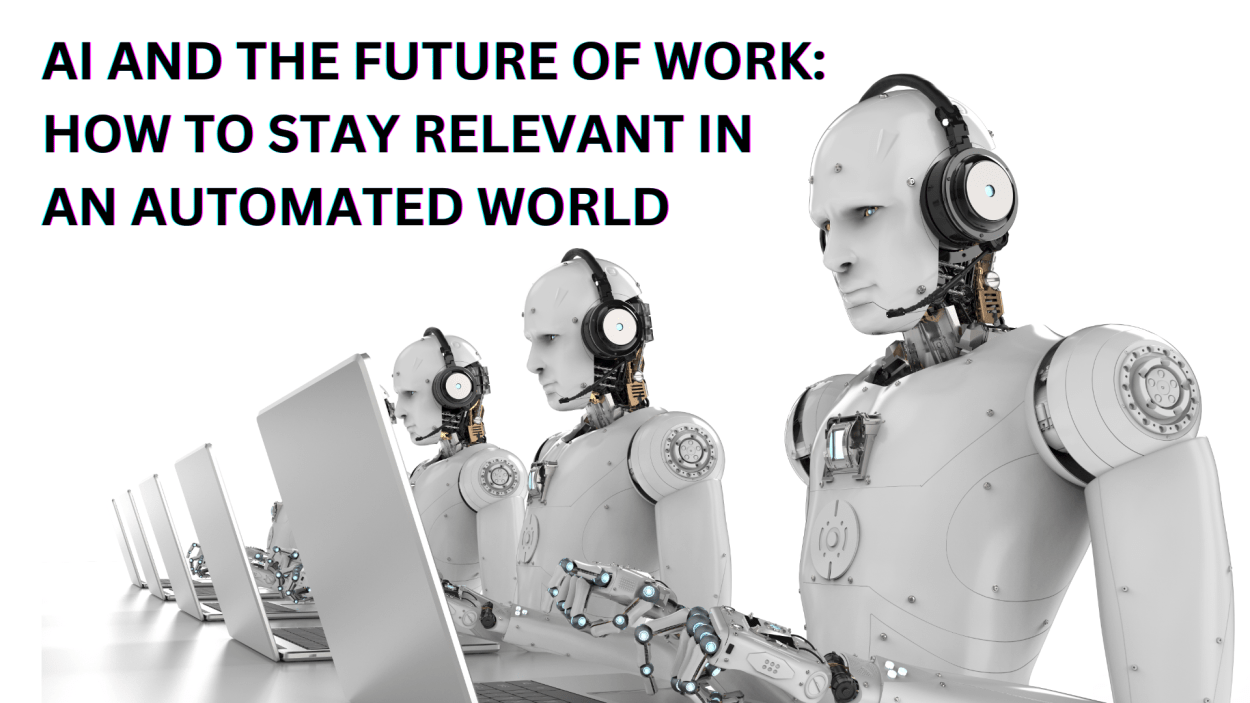
Artificial Intelligence (AI) is no longer a futuristic concept confined to the realms of science fiction. It is here, transforming industries and reshaping the job landscape. From self-driving cars to intelligent chatbots, AI is revolutionizing the way we live and work. But with these advancements comes a growing concern: the displacement of jobs by AI and automation. As machines become more and more capable, here comes the pressing question:
WILL AI TAKE OVER YOUR JOB?
The question is not whether you will be employed but whether the work you do will still mean something. Last week, you spent three hours writing a report. Then you saw a colleague produce a result 80% as good in just one minute using an AI agent. Maybe 90% as good if you are being honest.
The problem isn’t that the robots are coming. It is that you don’t know what you are supposed to be good at anymore. That Excel expertise you built over five years? Automated. Your ability to research competitors and synthesize findings? There is an AI agent for that. Your skill at writing comprehensive project updates? ChatGPT can do it better. Your specialized knowledge is no more an asset but a liability because you have poured all your time, effort, and career focus into something that is rapidly being automated. You are like the world’s fastest typewriter in the 1990’s.
Understanding the AI Impact
Every task automated results in cost reduction. The CFOs of the world look at the numbers: one AI subscription at $50/month can replace a $4,000/month junior hire. The math is easy. The choice is clear. According to a report by McKinsey Global Institute, by 2030, up to 800 million jobs could be lost to automation worldwide. However, not all jobs are created equal when it comes to AI’s impact. Here’s a breakdown of potential scenarios:
- Automation: Repetitive tasks with clear rules and procedures are prime targets for automation. Data entry, bookkeeping, and assembly line work are some examples.
- Augmentation: AI can enhance human capabilities in various fields. Imagine doctors using AI-powered diagnostics or lawyers leveraging AI for legal research. AI will become a powerful tool, not a replacement.
- New Job Creation: While the potential job losses are concerning, AI also presents new opportunities. Data scientists, AI ethicists, and specialists in human-machine interaction will be in high demand. The same McKinsey report suggests that AI could create 555 million new jobs by 2030. These new roles will likely require different skills and competencies, emphasizing the need for workers to adapt and upskill.
However, when it comes to job creation, we must remain mindful. A pivotal study by MIT economists Daron Acemoglu and Pascual Restrepo analyzed job data from 1947 to 2016. They found that before 1987, the economy was better at replacing the jobs lost to automation with new, similar opportunities. After 1987, this stopped being the case.
| Period | Jobs Lost to Automation (“Displacement”) | New Jobs Created (“Reinstatement”) |
| 1947 – 1987 | 17% of jobs | 19% of jobs |
| 1987 – 2016 | 16% of jobs | Only 10% of jobs |
From 1993 to 2007, the study found that each new industrial robot replaced about 3.3 jobs in the U.S. This imbalance is a key reason why automation is now linked more strongly to job displacement.
Read more here: Layoff Survival Guide: Hope for the Best, Prepare for the Worst
How to Prepare for the AI-Driven World
Everyone will tell you to focus on “human skills” that AI cannot emulate (well, not yet) — like emotional intelligence or soft skills. Alas, I’ve said the same myself. And while there is nothing wrong with that, the reality is that “human skills” alone will not guarantee you a job. Take accounting, for example: your employer won’t be impressed that you’ve become more empathetic or developed stronger ethical judgment if they can replace you with an AI agent that will perform 80% of your work at 5% of the cost.
1. Optimize for “Meta-Skills,” Not “Static Skills”
Stop trying to master a specific tool (like a specific coding language or a specific marketing platform). By the time you’re an expert, the agent will do it better.
- Focus on mastering Problem Decomposition and Agent Orchestration.
- If AI can execute the “how,” your value lies in the “what” and the “why.” Your job is no longer to be the carpenter; it’s to be the architect who knows exactly how to direct a team of automated carpenters.
2. Move Up the “Value Chain” of Collaboration
In the previous turn, I gave you the models of AI collaboration. To survive this cycle, you must consciously move from AI as a Tool to AI as Supervisor/Manager.
- Don’t compete with the agent; manage the agent. * If a task can be described in a manual, it’s already gone. Your value is now in Judgment, Edge-Case Handling, and High-Context Decision Making—the “Common Sense” layer we discussed earlier that AI still lacks.
3. Embrace “Micro-Learning” Sprints
Forget the 4-year degree. Its ROI is collapsing for knowledge work.
- Adopt a 3-month learning cycle. Identify a high-value “frontier” skill (e.g., AI-augmented data storytelling or prompt engineering for legal discovery), spend 90 days becoming “dangerously proficient,” and then immediately apply it to your current role.
- Use the agents to teach you the skills they are about to automate. It sounds paradoxical, but it’s the fastest way to stay one step ahead of the curve.
Conclusion
We can’t slow down the progress of AI, but we can change how we respond. The system isn’t designed for rapid role evolution — so we must design ourselves for it. The future belongs to those who adapt continuously, build portfolios of skills, and partner with AI to unlock human creativity and connection.
Good luck!
You May Also Like:
- What to Do When Your Employer Wants to Get Rid of You
- How to Avoid Getting Fired
- Harness the Power of AI in Your Job Search
What would you like to hear about next? Tell me at vaclav@getyourdreamjob.co
Do you want to get new posts directly to your mailbox? Subscribe here.
3 Ways how I can help you further:
- Get my book – Learn all the job search insider tips and tricks and use them to your advantage.
- Get my online course – Get access to aids, guides, workbooks, checklists, cheat sheets, and other exclusive content to speed up your job search.
- Work with me 1:1 – Book one of my coaching packages and get my personal support.
 Get Your Dream Job